
Kharra-tusk was traveling from a coastal fishing hamlet northwest of Myrrhion to the port of Pantokrator, hoping to board a merchant skiff that would reunite her with her scattered House. A squall line off the Scar’s outer shelf shattered the voyage. The rigging snapped, the deck split, and she washed ashore in Mor’s Port’s lower canals, half-drowned, hooves scraped raw against rusted pilings, clutching a water-soaked satchel and poor little Tarn.
The city didn’t care. Constables logged her as an indigent stray. Adults looked away. The port runs on ledger-weights and transit papers, not lost girls with no name and no coin. She spent weeks sleeping under tarped skiffs, begging for dry bread, trying to speak to harbor clerks who either couldn’t read her dialect or refused to waste paper on a stray. Every attempt to reach out ended in silence. The storm had already written her off.
Kharra-tusk is broad-shouldered but still soft with youth, her frame dense but not yet hardened by the heavy labor that defines most Teshkar adults. Her coat is a warm, brassy copper, thick around the neck and shoulders, with a natural sheen that catches the chartreuse glow of the Baldachin. Her face is distinctly Teshkar: heavy-lidded, expressive eyes framed by strikingly long lashes, a soft, rounded snout, and small, curved tusks just beginning to show their adult arc. Her hair–coarse, dark brown with copper highlights–is meticulously braided and tied back into two thick twin tails, clay beads adorning her locs. These were gifted to her by an elder she hasn’t seen since the separation. She carries a satchel of salvaged provisions, a water-stained House-mark, and a quiet-desperate hope that hasn’t yet been ground into the port’s usual cynicism.
The accident happened on the upper loading walkway, suspended over the canal where heavy galleons tie to rusted iron moorings.
Syll, Lyss’s sister, was a dockward surveyor, an adjunct to the harbor’s structural oversight. Where Lyss managed tariffs, permits, and the delicate fiction of port order, Syll managed iron and timber. She read the groan of a piling, the fatigue in a chain, the subtle lean of a loading crane. She signed off on moorings, condemned unsafe warehouses, and kept the canal gates from buckling under the tide. She was the practical half of their shared ambition: Lyss held the ledgers, Syll held the weight. They mirrored each other in discipline, in the quiet exhaustion of keeping a rotting port from sinking into itself.
It was during a Lull: the Baldachin’s light failed in the ‘Neath, the ambient hum of the port dropped, and Kharra-tusk–cornered on a rain-slicked gantry by constables, terrified, her untrained Lungs flaring in panic–instinctively tried to borrow stillness from the rusted iron around her. Her Breath thickened the air, pressing against a fractured mooring cleat, holding it in place against its own fatigue for half a heartbeat too long.
When the unseen weight released, the iron swung free like a pendulum.
Syll was inspecting the adjacent watergate. The cleat caught her across the ribs, driving her into the stone balustrade before she tumbled into the churning canal runoff. By the time the constables hauled her out, she was gone.
Lyss arrived to find the stress fractures on the cleat. They didn’t look like rust, they looked like the metal had been grasped. She saw the unnatural twist in the grain, the way the iron had resisted its own decay before snapping with catastrophic force. In that moment, she didn’t just see her sister’s body. She saw her own future: the slow, grinding effort of holding a broken system together through sheer will, only to watch it fail the moment invisible hands let go. No grand tragedy, just a city’s infrastructure giving way to a frightened little girl’s panic.
Lyss knew Kharra-tusk hadn’t meant it. She read the unnatural stress patterns, the way the iron had been pressed rather than pulled, the sheer terror in the constables’ accounts. But the Port Authority needed a ledger balance, and Lyss needed a buffer.
She framed the accident as a structural liability. “You damaged municipal property. You’ll work it off.” The tasks were never presented as punishment. They were presented as a settlement: retrieve a misrouted shipping manifest, clear a blocked drainage grate in a contested ward, deliver a sealed pouch to a Sump fence, sweep a contested alley of unauthorized refineries. Each task came wrapped in a promise Lyss knew she couldn’t keep: Clear your mark, follow the path, and the port will issue your transit papers. You’ll be able to track your House again. You’ll be able to go home.
It was a lie, of course. Lyss had no idea where Kharra-tusk’s family went. The caravan’s route fractured in the storm, the coastal registries flooded, and the lower docks don’t track refugee lines. But Kharra-tusk didn’t know that. She was young, naive, and desperate, and the path Lyss laid out felt purposeful: a straight, golden line through a crooked and tarnished city, promising that if she just kept walking, kept working, kept clearing her name, she’d eventually set sail again and find the people she was looking for.
But every completed task just pulled her deeper and deeper into the ‘Neath. Every cleared debt revealed another. Lyss didn’t enjoy it, telling herself it was mercy. Better to keep the girl moving than to tell her the truth: the port swallows strays, and the ‘Neath doesn’t give back what it takes.
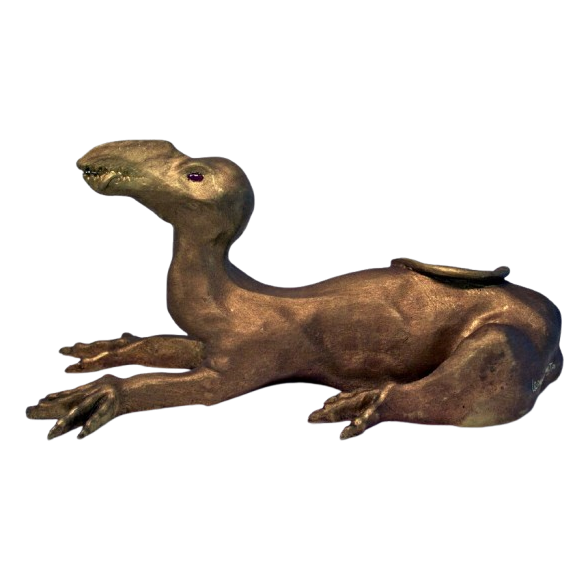
Kharra-tusk is not entirely alone. Tarn is a Veshi, a docile Teshkar-domesticated forager animal bred down to satchel-size through generations of selective pairing with runts that exhibited calm dens and precise digging claws. It carries the low, grounded balance of a burrowing animal, with powerful hind legs that coil like tensioned wire and forelimbs ending in long, curved digging claws that click softly against packed earth. Its face is blunt and soft-snouted, framed by large, dark eyes that track movement with quick, nervous precision. Broad, mobile ears twitch independently, catching frequencies most species miss: the shift of a boot on gravel, the drop in barometric pressure before a storm, the subtle vibration of a patrol approaching through wet soil. Its coat is dense and coarse, streaked in mossy browns and rust-reds that mimic turned loam. The fur sheds mud effortlessly, a trait carefully selected by Teshkar breeders who needed companions that could work in damp fungal beds without carrying rot or disease back to the hearth.
Teshkar originally bred his kind to clear root-rot, signal inclement weather, sniff out blight in dense fungal beds, and carry seed-pouches through narrow irrigation channels where larger hands couldn’t fit. In the ‘Neath, he serves a simpler purpose: he lives in her satchel, peeking over the rim when they stop moving, climbing up her tunic to curl against her collar when the air turns cold, and chittering sharp warnings when strangers linger too close. He’s a working animal, the Teshkar equivalent of a barn cat or turnspit dog. Tarn hoards small things: copper tariff-chits, broken glass beads, smooth river stones, discarded ledger-seals. He fits inside her satchel completely, and when he does, he goes perfectly still, content to be warm and by Kharra-tusk’s side. He’s the only piece of her House that made it through the wreck with her, and he keeps her grounded when the dark becomes too silent.
Kharra-tusk isn’t blind to the arithmetic. She’s young, disadvantaged, and miles from the fungal beds and House-structures that shaped her, but she’s far from stupid. She notices how the tasks never end, how the “clues” always point to another ward, another debt, another sealed envelope that takes days to deliver and yields only another stamp of approval. She suspects the yellow-brick road is a treadmill. Lyss isn’t cruel; she’s pragmatic. She’s buying time, keeping Kharra close enough to monitor and useful enough to justify the upkeep. In exchange, Kharra-tusk plays the part. She nods, she runs the errands, she accepts the rations. But she’s watching. She’s mapping. She’s counting the days between Lulls, learning which constables take bribes, which alley-cats know the dry routes, and which drainage grates haven’t been welded shut since the last flood.
Word of Charis-Vey, the Curator, travels in Mor’s Port like damp-rot. Kharra-tusk heard it from a bonebreaker dockworker who traded her a dry blanket for a Chronics-attuned knot that kept his cargo from shifting in a storm. “Surface runs in circles,” he told her. “Underground runs on blood and ledgers. If you want out, you don’t ask the Bubble Witch. You ask the man who holds the pipes.”
He already knew her name.
The summons arrived three weeks ago, slipped into her satchel beneath a layer of dried kelp. No seal, no signature. Just a single brass ledger-chit stamped with an eight-armed sigil, and a slip of oil-treated paper bearing a time, a coordinate, and a phrase in rough, phonetic Teshkar. Lyss hasn’t seen it. If she had, Kharra knows she’d never leave her room again.
Kharra isn’t stalling or running in blindly, she’s been preparing. She’s stockpiling rations, weaving a water-resistant cord from scavenged hemp, and practicing her Chronics in the quiet hours before dawn–thickening the air underhoof to muffle her steps, borrowing stillness from old, rusted nails to slip past ward-guards. Tarn has learned to read her tension, chittering warnings when constables linger.
She doesn’t trust the Curator. She knows what he is: a spider who weaves truces from debt and broken ventilation shafts, who dangles people like puppets in his tangle of threads. But she also knows Lyss’s promises are calibrated to expire. Charis-Vey’s offer might be dangerous, but it’s honest about its hunger. The ‘Neath doesn’t pretend to be home the way Lyss’s house does. It just asks what you’re willing to trade for passage.
Kharra-tusk is a pivot point, a disadvantaged kid caught between surface bureaucracy and underground syndicates, learning to navigate a city that treats her like a stray but underestimates her like a child. She’s naive enough to hope, clever enough to plan, and pragmatic enough to know that survival in Mor’s Port doesn’t come from waiting for rescue. It comes from reading the ledger, finding the gap, and stepping through before the dark closes in.