Tucked within the outer fractures of the Scar, Plague-Stede does not announce itself. It reveals itself in pieces, like a settlement assembled from ruin. To the casual eye, it reads as a collapsed border waystation left to the glass-winds: patchwork canvas stretched between Chrysalid ribs, bridges of knotted silk and braided hair, towers of rusted iron and resin-sealed clay leaning at angles that should send them toppling, yet they hold, the lashings flexing with the city’s breath.
There aren’t any straight lines in Plaeg-Stede. Walls curve to break sightlines; doorways sit half-submerged in glass-sand, forcing approach by crawl, staircases reverse direction every third landing to disorient pursuers. This is not whimsy, but defense. The air carries the scent of ozone and old burlap, of fungi blooming in shaded crevices and resin still curing in the sun. Beneath it all lies the sharp, clean smell of the thin Yolk-Vein humming beneath–like lightning trapped in stone. At night, courtyards glow softly with iodine-red light from bioluminescent molds, and the Vein’s vibration rises into the teeth and bones.
Plague-Stede is not a playground in any frivolous sense. It i a refuse built by hands that have never known gentleness, but insist on making it anyway. Every structure is lashed, stitched, glued, or nailed together with a desperate ingenuity. Makeshift bridges and zipline stretch between signal towers armed with light-refracting mirrors at the top. Early warning systems of shrapnel wind-chimes sway gently in the ever-present breeze, sinew trip-lines marking the perimeter. It is weathered, scarred, and fiercely alive. It does not promise paradise, but holds. This is why it is also known as The Glass Cradle.
Plaeg-Stede was originally a border farming/artisan settlement built along a thin Yolk-Vein node. Like most cases, the vein wasn’t understood as magical; it just made the soil stubbornly fertile, the clay unusually pliant, and the air quiet enough for deep focus. When the Cataclysm hit, the town was evacuated and partially consumed. The children who fled here approximately a decade later didn’t know the myths they heard were echoes of a real place, they just followed the peace and quiet.
A modest human and mixed-kin farming waystation, Plague-Stede was forgotten by imperial supply lines and spared the worst of the Cataclysm’s vitrifying edge. When the sky turned white and the air burned, its inhabitants fled or became Valravn. The town was left to the wind, the glass-storms, and the thin Yolk-Vein humming beneath its foundations.
The story of its return did not come from elders. It slipped through the cracks of adult attention: a game of whisper, passed notes, and stolen glances exchanging hands from child to child in cellar corners, market alleys, chapel pews, and crowded dormitories. Adults dismissed it as pretend, but the children knew better. They felt it in their teeth when they heard the name: a place that belonged to them, if they dared to claim it. They did not know it sat on a Yolk-Vein, they knew only that it was waiting.
Roughly ten years after the Cataclysm, children began to arrive.
They did not run in panic. They planned. Over months, they hoarded scraps, mapped star-charts on stolen parchment, forged alibis, tested escape routes, and waited for the right wind. When the night finally came, they slipped out together (no older than twelve) carrying only what their little arms could carry and a certainty they could not explain.
The journey was brutal. Longer than any of them had imagined. The Scar’s outer fractures chewed at their shoes, the glass shredding the leather soles as their water supply was drank by the sun and their own mouths in equal measure. Screams in the night winds robbed them of their sleep. And yet, somehow, it held. Doors were left unlatched for them. Strangers shared bread without asking names. Storms parted just long enough to let them cross a ravine. It was not a miracle, not exactly. It was as if the world itself recognized their emancipation, and chose not to stop them.
They arrived at Plaeg-Stede with blistered hands and empty bellies, but they did not break. They set to work. Salvaged timber was nailed at crooked angles. Chrysalid bone and rusted iron were lashed together with silk-threads and hemp rope. Colorful scraps of canvas patched shattered glass. Clay mixed with ash and resin to seal cracks. The children regrew Plaeg-Stede with hands that had not yet finished growing, driven by a quiet and stubborn reciprocity that adults had long forgotten how to practice.
More followed. They came from shattered orphanages, from war-caravan remnants, from settlements that had learned to discard what they could not control.
Through the sheer weight of shared purpose, deliberate cooperation, and the quiet insistence on staying alive together, the settlement crossed a threshold. The children leaned into the city, the city into the Vein, and the Vein back into it. Plaeg-Stede did not just regrow: it merged.
Plaeg-Stede is not a playground in a frivolous sense. It is a refuge built by young hands that have never known gentleness, but insist on making it anyway. The structures lean, ropes are made of knotted silk and braided hair, and early-warning systems comprised of glass and metal shrapnel alert them ahead of magickal storms. Glass-refraction mirrors are positioned strategically around the settlement for signaling, with sinew trip-lines and spike pits around its perimeter for defense.
Daily life is blunt, functional, and fiercely communal. Leadership is role-based, not age-based. Decisions are made through consensus polls, games, shared oaths, and ritualized storytelling. Conflict resolution is not sanitized. It is faced, argued, mediated, or burned out when survival demands it. The children share space, share the weight of responsibility, and have learned to carry it all together.
Play here is not escape, it is rehearsal. What appears to be a mere game is actually a training drill, what seems like a story is actually a map, and a toy to an adult is a tool to a child of the Glass Cradle. Joy is resistance, and scarcity bites. Trust is hard-won, but loyalty is absolute. The city does not promise paradise, but it does promise to hold.
The city’s nascent godhood does not speak. It manifests as The Shepherd, a child-sized specter assembled from the settlement’s own debris: a shepherd’s coat of patched canvas, cracked river-stone eyes, and a crook of charcoal and twisted rebar. It is not a ghost, but it is a constant, uncanny presence within Plaeg-Stede. It is thought of as a peer with authority.
The Shepherd communicates through rearrangement. It clears paths, bars doors, places weapons within reach. It can be heard in wind-chimes tuned to specific patterns, or seen in shadows that move independently of light. It does not coddle, it ushers. The Shepherd cares about what the children care about: fairness, shared scarcity, the preservation of play as practice, the refusal of hoarding. It will leave a mended toy at a grieving child’s bedside. It will just as likely break fingers to stop a fight or collapse a tunnel to down a pursuer. It is shaped by the city as much as it shapes the children. When they play, the city adapts, and when they fear, it fortifies.
Though the children of the settlement never seem to physically age or meaningfully mature at all, the thin Yolk-Vein beneath Plaeg-Stede does not halt aging. It emits a developmental frequency that has come to be known to the children as The Unsettling Current–a slow, subsurface resonance that actively disrupts metaphysical calcification. It works like a hidden riverbed that refuses to let silt settle into stone. In children, it keeps the soul’s clay damp and workable, the Breath unknotted, the threads of experience loose enough to be rewoven with each passing season. Development remains in flux. Plasticity stays active. The Vein doesn’t stop growth; it prevents it from locking into a single shape.
In adults, or those whose minds have already hardened into fixed patterns, the Current does not soften, it grinds. Their metaphysical sediment has already baked into place. When they enter Plaeg-Stede, the Vein’s resonance doesn’t erase them; it vibrates against what is already set. This causes calcification feedback: a literal bone-deep ache that worsens the further one is from childhood or nascency. Joints tremor and throb with pain. The chest feels heavy, as if breathing through wet wool. The mind experiences constant pressure: conversations loop into themselves, familiar paths seem to narrow or suffocate, and tools feel misaligned to the hand. Paranoia spikes as rigid worldviews scrape against a space that refuses to hold still. Those who are still “child at heart” may weather the mental strain, even finding the quieting of fixed thought pleasant, but the physical grind remains. It is not malice, just incompatibility.
Physically, adults can enter, but they are forbidden by decree.
“Grown eyes break the weave.” Taught from day one. Absolute. Non-negotiable. Adult paradigms run on hierarchy, control, utility-over-possibility, and trauma duplication. Plaeg-Stede runs on consensus, adaptability, shared scarcity, and radical reciprocity. Enforcement of the decree is cultural, martial, and viewed as completely necessary. The settlement’s perimeter, choke points, traps, and misdirection tunnels are patrolled regularly. Breachers are captured, disarmed, stripped of rigid belongings, and placed in dampening cells. They are marched out within 24 hours. Resistance is met with lethal force. This is seen as triage rather than cruelty. The city is built by and for children; it does not cater to the adult form in any way, and adult presence risks disrupting the settlement’s harmony.
Plaeg-Stede did not sit atop an active Yolk-Vein before the Cataclysm. For centuries, concentrated divine potential pooled beneath the bedrock like pressurized sap in a sealed vein, dormant and directionless. The Cataclysm changed that. The detonation’s shockwaves cracked the Nest’s crust like a hairline fracture in fired porcelain, depressurizing the trapped energy and forcing it upward into a thin, newly-formed node. The Yolk-Vein did not erupt, it bled, seeping into the soil, warping local resonance, and leaving the land quietly alive in a deeper sense than before. The original settlement fled as the winds came, and a little over a decade later, children returned to a place that had already begun to Breathe.
The children did not merely rebuild, they organized. From the oldest and most capable rose The Shepherd’s Chapel, the city’s spiritual and civic authority. It is not a monarchy or a democracy, but a rotating stewardship grounded in consensus, oath, and shared scarcity. Alongside them stood the Watch-Hands: the city’s perimeter guard. They were not necessarily soldiers. They were trappers, scar-readers, and silent coordinators who maintained choke points, acoustic alarm systems, and misdirection tunnels. Their duty was simple: keep the walls standing, keep the quiet intact, and keep the grown-ups out.
The Shepherd did not speak in words, but in dreams. It began visiting certain Watch-Hands and a few civilians who slept near the perimeter, showing them the same vision: a heavy, inevitably presence moving through the Scar. It was called The Settler.
It did not hate children, it simply could not abide potential left unshaped. It was drawn to the thin Yolk-Vein beneath Plaeg-Stede, intent on tapping it, anchoring it, and turning the city’s plasticity into something fixed, final, and lifeless.
Most who received the visions buried them. Some out of terror or quiet denial. A few packed their things and slipped away into the night. Only nine in total stepped forward. One was not a Watch-Hand at all, but a civilian child whose desperation outweighed her fear. They gathered beneath a patched canvas awning, placed their hands on a rusted iron plate, and swore an oath: to walk outside of the walls, to block the path of the Cradle-Smasher before it is walked, to strike at its feet before they step. The Chapel pleaded with them to stay, but the Nine turned their backs, and the Schism of Small Hands began.
The Settler is a Scar-born phenomenon of ambition manifest. It does not hate children, but it cannot abide potential left unshaped. Drawn to the thin Yolk-Vein beneath Plaeg-Stede, it was intent on anchoring the Vein’s raw developmental current into a fixed, usable form. To do so would shatter the city’s plasticity, calcify the children, and turn the refuge into another lifeless ruin. It smashes what blocks it because hesitation is a flaw in its nature.
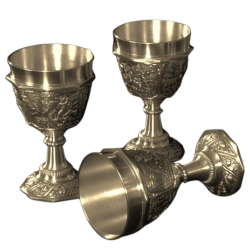
They found the Eltanin Chalice not as a prize, but as a necessity. It is called a chalice not for its shape, but for its function: a vessel through which communion with the divine is performed. To the locals of the outer Scar, it is nothing remarkable: a fossilized Chrysalid antennae jutting from a weathered mound, preserved in unnatural detail only because it survived the Cataclysm’s heat. It belonged to a long-dead ascended Chrysalid, its fossilized body buried deep in the bedrock, pierced directly by the trunk of the thin Yolk-Vein. The Nine sought it out for communion and, pressing their palms to the fossilized chitin, the Vein answered.
It did not elevate them. It unlocked them. They were granted perception to see The Settler’s path before it walked, to move as to always block its approach, and to strike with utmost precision at its feet. It weaponized devotion.
But the Eltanin Chalice did not just enhance them, it caused the newly christened Vow-Bound to overgrow. Their spiritual maturation outpaced their physical and mental development. Their nervous systems stretched, joints warping, muscles pulled taut. Their bodies became longer, sinewy, optimized for a war that never ends. Their faces remain frozen at departure age: smooth, soft, childlike. But the spirits have outgrown their vessels.
The Chalice’s frequency replaced the cleansing hum of the Vein with a hyper-focused war-resonance. Over time, motor control degrades into hyper-efficient violence. Hands that once mended toys now snap necks without hesitation. They manage this through binding rituals, vocal hums, isolation when it peaks, or self-imposed oaths and restraints. But it is slowly worsening. Eventually, their bodies will become uncontrollable vehicles for violence. The surviving Nine know this, and walk anyway.
This war-resonance fundamentally clashes with Plaeg-Stede’s harmonic field. Crossing the threshold would trigger mass calcification feedback, cracking the Vein and shattering the city. Poisoned by their own salvation, their relationships with others are inherently temporary, interaction with others kept brief while proximity to Plaeg-Stede is forbidden. The city-spirit rejects them to protect the children.
The initial confrontation did not end The Settler, it only broke its momentum. Three of the Nine died in that first clash, not to glory but to simple, brutal attrition. There were no last words, no clean sacrifices. Just blood staining the sand and sudden silence where a heartbeat had just been. The Nine became six through loss, not design.
The Settler was never destroyed. It retreated, settling into a slower, grinding rhythm. It returns, but its return is as pressure, not an apocalypse. A wrongness in the wind. An unusual stillness in the Scar’s chaos. The Vow-Bound have adapted. It’s work to them now. Brutal, repetitive, necessary work.
They do not live together because they cannot. The constant war-song isolates them, and the Shepherd’s Chapel’s frequency demands space to keep their corruption from feeding into one another. Three walk alone. Two are forever paired. One drifts between them, touch-and-go, lingering with the pair when the resonance runs heavy, vanishing when it thins. They only convene now when The Settler’s presence spikes–a hitching distortion in the Breath, a sudden spike in Scar-storms. They gather. They fight. They bleed together. They scatter apart. There are no debriefs, no shared fires. Just the work, and the quiet understanding that someone has to hold the line.
Their relationships are not brotherhood. They are bound by trauma, oath, and the shared weight of a forever-war. Unspoken guilt. Quiet care disguised as tactical necessity. They know each other’s tells: how one’s left knee clicks before a lunge, how another’s Lungs wheeze when the corruption peaks, how the pair moves as a single organism while the solo walkers keep their distance. They do not trust easily. They do not forgive easily. But they show up. Every time the pressure builds, they show up.
One of the lone walkers keeps a singular oath: she personally escorts children in need to Plaeg-Stede’s perimeter, walking them to the edge of the glass-strewn ravine, then stopping short of the gates. She cannot cross, and she never will again. She watches them run to the walls, turns her back, and walks into the Scar again. It is the only thing she does that does not require violence. It is the only thing that reminds her of what they were fighting for.
- ✦The Chapel — The dormitory and facility of The Shepherd's Chapel.
- ✦The Wall — A brutalistic wall constructed from the ruins of Old Plaeg-Stede by the foundling children of Plaeg-Stede.