
Uruuli are omnivorous gourmands, their diet reflecting the dangerous bounty of their environments. Insects, crustaceans, spicy greens, eggs, and elves form the core of their diet. Elf meat is considered a delicacy when consumed fresh; preserved or frozen flesh is regarded as an insult to the meal and the diner both.
Sugarcane, duckweed, and cucumbers are sacred, finding their way into most aspects of Uruuli life. Beyond their role in traditional dishes, they are used in rituals, medicines, and offerings of peace. Many foods are preserved or pickled using sugar-based methods.
Traditional Uruuli dishes include thinly-sliced Gamoran meat served with citrus and lotus root sauce, a pungent condiment made from fermented insects, Sugarwine made from a cane plant that is notably not sugar, and live bugs and crustaceans served as they are. Land mammals such as the Dwa'w sit at the opposite end of the Uruuli's esteem — dry, stringy, difficult to digest, and generally considered unworthy of a discerning palate. Such meats are cooked for long periods in stews until nearly dissolved, and consumed only when nothing better is available.
The Uruuli are not a unified people but a loose confederation of Pools, each centered around a body of water deemed sacred through a process that is forbidden to outsiders. Swamps, underground lakes, rainforest rivers, and cenotes may answer the call. The water determines their form, their magic, and their fate.
At the heart of Uruuli culture is a practice of wrestling that traces back further than their written history. It is a sacred oil-slicked struggle: two warriors meet in a mud pit or on a woven duckweed pad within a floating ring of strung flowers and cucumber slices. They circle each other in movements that are fluid and deliberate, mixing explosive leaps with slippery grappling. There are no weight classes and no time limits — only the rule that the fight must end with one contestant pinned for the count of three, marked by the referee's hands clapping together.
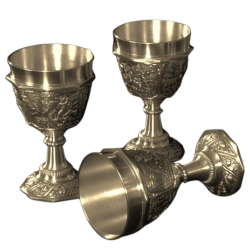
Before the fight, the wrestlers anoint one another in blessed oils and share a cup of Sugarwine, a fermented and intoxicating beverage made from cane plants native to Uruuli rainforests. This serves simultaneously as symbol of unity before struggle and as performance-enhancing drug. The wrestlers use everything available to them: sudden feints, the sheer force of their legs, and toxin-coated grips where they can get away with it.
Victory earns a garland of cucumbers and flowers draped over the shoulders and a victor's feast of duckweed and fish roe salad. Defeat delegates the loser to janitorial work — a social humiliation that in some Pools carries the genuine possibility of Kegri exposure, and therefore functions as a potential death sentence. This ensures no one takes the match lightly.
Early human accounts frequently misclassified Uruuli as sexually dimorphic due to environmental morphing — a conclusion later abandoned after repeated violent refusals of study. The Uruuli possess no concept corresponding to sex or gender. Their language contains no pronouns, no grammatical gender, and no categorical distinction between bodies based on reproductive role or morphology. Attempts by outsiders to classify Uruuli along such lines are uniformly rejected and often met with hostility, as such inquiries are considered invasive, irrelevant, and fundamentally misguided.
In Uruuli thought, identity is understood as a pattern of resonance shaped by the Basin, Pool of birth, inheritance, and lived history. Bodies are treated as variable vessels of that pattern, not as markers of social function or hierarchy. Names do not encode gender. Roles, occupations, and ritual positions do not imply it. Pairing, intimacy, reproduction, and kinship occur without categorical framing and are governed instead by Pool custom, consent, resonance compatibility, and practical circumstance.
When speaking Manstongue and other languages that rely heavily on gendered pronouns, Uruuli speakers experience pronounced difficulty. The act of assigning a third party to an abstract gender category feels deeply disrespectful — it reduces a living pattern to an external label. As a result, they often avoid pronouns entirely, repeating names or using direct address even when this produces stilted speech. Outsiders frequently interpret this as evasiveness or rudeness.
Some Pools go so far as to consider enforced gendering a form of Kegri — not metaphorically but ontologically. To impose a categorical structure where none exists is understood as contamination: introducing foreign patterns into something that was whole without them. It is notable that Uruuli cymatic practices show no variance correlated to bodily form. Resonance responds to pattern and orientation alone. The Uruuli cite this as sufficient evidence that sex distinctions are a concern of outsiders, not of the Basin.
The magick of the Uruuli arises from resonance, not force. Uruum, translated literally as "Basin-Resonance," is the word Uruuli use among themselves — though this did not prevent outsider academics from coining the term Cymathurgy to describe the same phenomenon. The Uruuli barely tolerate this. Cymathurgy persists primarily in Gamoran academic circles, where it is widely considered more pronounceable than accurate.
The unique anatomy of the Uruuli allows them to produce vocalizations that generate standing waves in fluids and semi-fluids: water, air, mist, blood, lymph, bile, acid, and neural slurry in cases of traumatic injury or advanced ritual violence. These waves organize matter into temporary mandala-like pressure forms, visible when the medium is dense enough, invisible but still operative when it is not.
These vocalizations are not songs. They are reflexive, animal, sometimes involuntary sounds produced by a resonant organ called the keluun — not a single structure but a soft, folded resonant chamber threaded within the throat and upper chest, composed of flexible cartilage, reed-like tissue, and mucus-rich membranes. It functions as a living basin of Breath, forming intention into standing wave patterns before they are released into the surrounding medium.
The intention of the caster matters, but intonation matters more, and the environment completes the spell. Dry air, stagnant water, and crowded bodies all warp outcomes. Once released, regretted ripples do not stop. The Uruuli introduce a disturbance and then allow reality to decide how to resolve it. They cannot create patterns from nothing — only amplify or destabilize patterns already present.
Use of Uruum originates in healing, though even ancient Uruuli healing magic is slow, uncomfortable, and invasive. Intermediate registers heighten reflexes, dull pain, sharpen vision, and induce trances. The last register is used for violence: aneurysms, liquefaction of organs, seizures, hallucinations, blood pressure spirals, forced paralysis, and induced drowning inside the body.
Damage, malformation, or absence of the keluun renders an individual unable to speak Uruum. Such conditions are congenital in some Uruuli and may also arise from injury, infection, or advanced Kegri exposure. Uruum cannot repair the keluun — attempts to do so invariably worsen the damage. The organ's structure is too sensitive to resonance to be safely manipulated by it.
In recent generations, certain Pools have developed artificial resonance instruments designed to approximate the keluun's function. These devices consist of layered chambers, damp reeds, and tensioned membranes crafted from animal tissue and treated cartilage. To remain functional they must be kept continuously moist and re-tuned frequently. Components degrade rapidly and must be replaced by skilled artisans. Use of these instruments is physically taxing and imprecise. The user must learn the individual device's responses through trial, error, and sometimes injury. Even in expert hands, resonance is unstable, and prolonged use often results in throat damage, hemorrhage, dizziness, or loss of consciousness.
Because of their cost, required maintenance, and danger, resonance instruments are rare and largely restricted to wealthy or politically powerful Uruuli. Their existence is controversial regardless. Traditionalists argue that externalizing the keluun profanes the Basin by severing resonance from the physical body. Others view them as necessary accommodation for Uruuli otherwise barred from speaking Uruum entirely.
The most troubling implication is that resonance instruments are not biologically keyed. With sufficient training, members of other species can use them to speak Uruum. Such usage is widely regarded as sacrilegious, appropriative, and dangerous, and is explicitly forbidden in most Pools. Nevertheless, rumors persist of outsiders who have learned to Breathe the Basin through stolen or purchased instruments — often with catastrophic results.
Kegri is both a physical contaminant and a spiritual condition, inseparable in Uruuli thought and language. The word predates written history and refers simultaneously to a state of ritual pollution, a loss of resonance, and the presence of a specific disease-causing substance. There is no distinction made between metaphor and matter: to say a Pool is Kegri is to say it is unclean in every sense that matters.
Among humans and other species, Kegri is most often understood as a wasting disease or environmental poisoning — recorded in surviving human sources as the Grey Rot, a name describing the progressive paling and deterioration observed in afflicted bodies and settlements. Its effects are most severe among the Uruuli due to their porous skin, chemically active tissues, and acute sensitivity to resonance.
Physically, Kegri manifests as a pale, mold-like growth forming in stagnant or wounded bodies of water, particularly those once deemed sacred. It appears as a chalky film, fibrous bloom, or fine mineral dust suspended in the water column, often clinging to stone, bone, plant matter, or organic debris. When disturbed, it releases spores or clouds of particulate that shimmer faintly before settling.
In early stages, the afflicted appear merely ill, fatigued, or withdrawn. Prolonged exposure causes visible fading: skin, scales, fur, feathers, or leaves lose saturation, becoming ashen, chalk-white, or translucent. Lichen-like rashes emerge along joints, gradually thickening into lesions. Internally, Kegri produces mineralized accretions resembling barnacles, coral, or calcified lichen — anchoring to organs, blood vessels, and bone, layering slowly and irreversibly. As the disease advances, these accretions erupt outward through the skin, forming crusted plates, branching growths, or reef-like protrusions that bleed, crack, and continue to grow. In extreme cases, the afflicted body becomes a living substrate: less organism than scaffold. Removal is impossible without fatal damage.
Even gently spoken Uruum intended to soothe pain only intensifies suffering in the afflicted, producing feedback that accelerates growth and neural distress. Neurological decline follows contamination: confusion, memory loss, emotional volatility, and eventually organ failure. Death is common. Survivors are permanently altered, their resonance damaged, their patterns producing warped or inverted effects. It is said that those who die of Kegri do not settle in the gentle waters of the Basin, but echo discordantly within it.
Kegri is believed to arise when sacred waters are neglected, profaned, or overworked — especially through careless or excessive Uruum use. Repeated resonant disturbances without proper stewardship can cause standing patterns to collapse inward, creating conditions that invite Kegri to take root. Once established, attempts to purify Kegri through magic alone fail and often accelerate its spread.
Spiritually, Kegri represents severance from the Basin's harmony. The afflicted are considered ritually unclean not as moral judgement but as ontological fact — their presence destabilizes Pools, tools, and communities. Individuals showing clear signs are often isolated or exiled long before death. Importantly, Kegri is not considered evil. It is understood as sacred matter that has lost its orientation and begun to rot.
There is no cure. Containment requires physical intervention: massive irrigation efforts, draining entire Pools, scraping contaminated surfaces, burning organic matter, and removing tainted sediment by hand. Protective oils, garments, and counter-resonant chants reduce but never eliminate risk. Those tasked with Kegri removal are either the deeply pious or the condemned. The work is slow, dangerous, and frequently fatal. To touch Kegri is to accept that one will never again be regarded as fully clean. In some Pools, failure in ritual combat or grave transgression results in assignment to Kegri work — a punishment that doubles as penance, and which ensures that the janitorial position is never taken lightly.