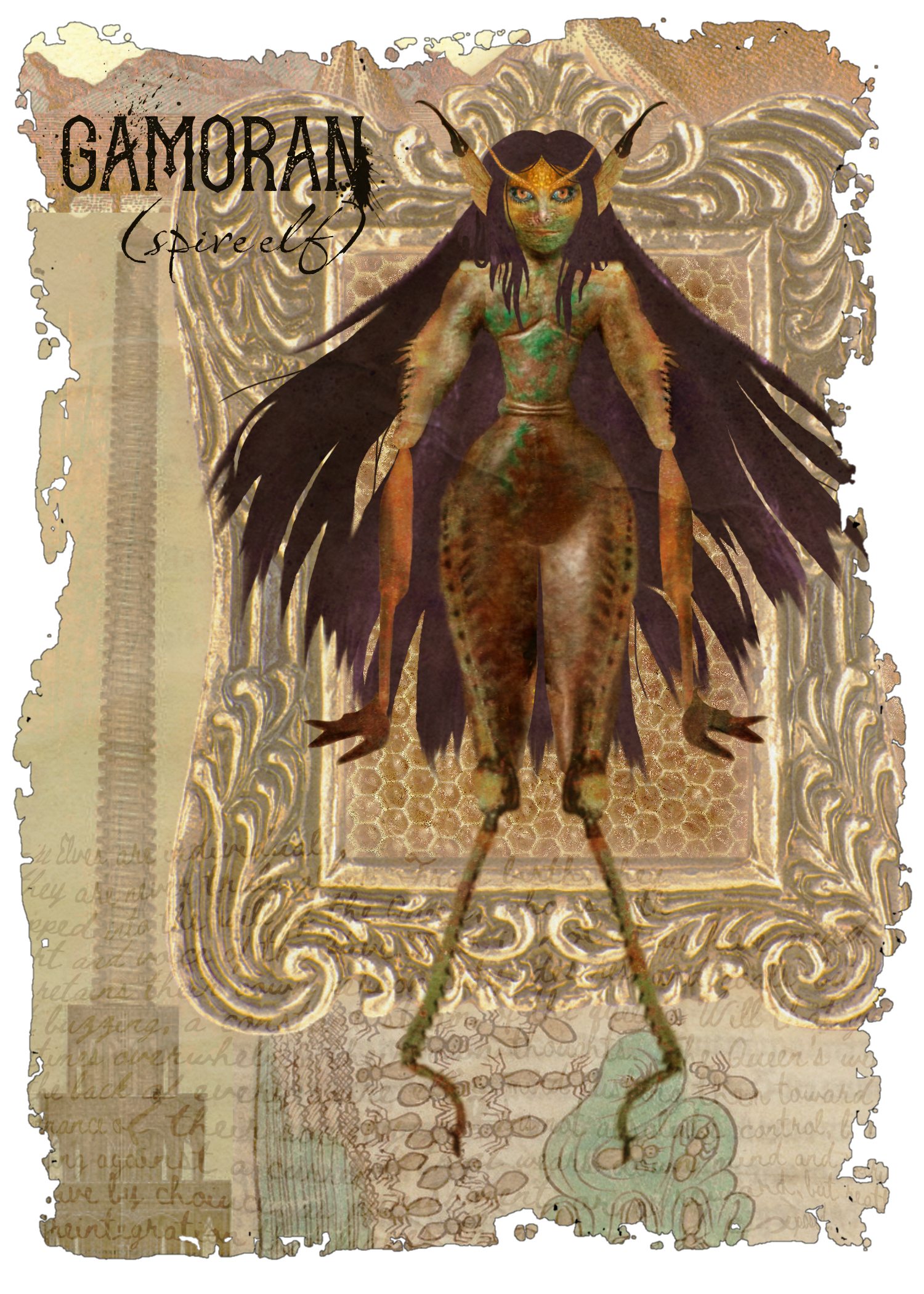
Gamorans are individuals, but they are never truly alone. From birth, every Spire Elf is tapped into the will of the Queen — a constant psychic hum that guides, nudges, and sometimes overwhelms their own thoughts. This is not a true hive mind. Each elf retains their own personality, desires, and goals. But the Queen's will is a soothing, insistent presence in the back of the mind, pushing toward compliance, duty, and the maintenance of their society. Resisting it is painful, like swimming against a current that wears down mind and spirit over time.
Detachment from the Hive is possible — by choice, as punishment, or as a rare reward — but reattachment is violating. A forced reintegration leaves the elf raw and exposed for days. Those who are not Hive-blooded can temporarily attune to its whispers, but the connection never lasts, and the experience is often overwhelming, addictive, and maddening.
Gamoran civilization endures as a gleaming contradiction: an empire of immaculate order sustained by paranoia, propaganda, and the quiet cannibalism of its own elite.
Gamoran society is not merely organized by class — it is ossified by Spires. Each Spire is simultaneously a bloodline, an ideology, a profession, and a myth. Every Spire traces its origin to a singular founder whose legend reshaped the Hive: a peerless architect, a war-saint, a diplomat who bent empires with a word, an alchemist who first stabilized Ichoryn, a martyr whose death became doctrine.
What begins as reverence calcifies into obligation. Every child born into a Spire inherits not only a name but a destiny already written. Talent is no longer discovered — it is assumed. Failure is not personal; it is heresy against your bloodline.
High Spires are rigid, paranoid, and profoundly corrupt. Over-attuned to the Queen's will, their members drown individuality in ritualized obedience and Blodhoney. Intrigue replaces innovation. Incestuous politics, quiet assassinations, and ceremonial cruelty are justified as necessity.
Middle Spires function as administrators, strategists, and cultural enforcers. Their corruption is pragmatic rather than decadent — but no less cruel.
Lower Spires are markedly more person-like. They love fiercely, feud loudly, and laugh crudely, maintaining something resembling selfhood. And yet, even here, pride poisons them. The Hive teaches contempt as fluently as it teaches duty. Even the lowest-tier elf sneers downward at those with nothing left to lose.
The Spires perpetuate themselves as vertical prisons, rising ever higher while their foundations rot. The Queen relies on this structure — divided houses cannot unite against her, and ambition keeps them too busy devouring one another to question the Hive itself.
The Queen is worshipped as a goddess and living conduit for the will of the Hive. She is rarely seen, emerging only for births, deaths, and sacred rituals. Her mind is never truly her own — she dreams in the voices of her ancestors, sees architectures that do not yet exist, and commands the Hive's very Breath. Her thoughts are echoes. Her words are prophecies. Her will is law.
The Queen's transformation is achieved through Ichoryn — a ritually refined form of Blodhoney unique to Spire Elves, sweet and luminous but dense, almost sentient. Administered in incrementally increasing doses through food, alchemical unguents, and dream-glazes, Ichoryn elongates the limbs, densifies the carapace, veins the flesh with golden bioluminescence, and eventually produces wings. A Queen must eventually lose her wings — shedding them is both symbolic and biological, required for the perpetuation of the colony. A Queen who fails to drop her wings is considered infertile regardless of anatomical reality, and the consequences range from political isolation to dethroning and death.
The succession is known as the Game. Once a generation, a cohort of Sisters are raised on Ichoryn and trained in politics, metaphysics, assassination, etiquette, warfare, poetry, and seduction. They are not told they are rivals. The Game is sacred — and never acknowledged aloud. Everyone in court knows it is happening, but to name it is to lay your neck on the Executioner's stump. Mentorship becomes manipulation. Most sisters die young. The royal guard does not interfere — their prime directive is obedience to succession, not morality.
The Game ends when only one remains. To be a Queen is not to win. It is to survive, and never admit you were playing.
Among Spire Elves, a name is not merely an identifier but a ritualized assertion of lineage, hierarchy, and intellectual sovereignty. In Manstongue, the full ceremonial name must always be spoken in its entirety: Given Name of the Spire of the Spire's Specialty. Example: Mazdaq of the Spire of the Flayed Equation.
Omission or abbreviation in Manstongue is understood as a deliberate act of disrespect — to shorten a Spire Elf's name is to deny the authority of their Spire and, by extension, the epistemic domain it governs. By compelling outsiders to recite long, ornate titles, Spire Elves transform address itself into submission.
In the Hive's tongue, a secondary untranslatable form exists, compressing the full Spire title into a symbolic epithet intelligible only to those fluent in Spire culture. This form is never used in formal cross-cultural discourse. A further shortened intimate form — Mazdāq Moʿ — signals rare trust when given sincerely, or calculated insult when given to an outsider, reducing the Spire's grandeur to something deliberately incomplete.
How one speaks a Gamoran name determines not only meaning, but one's position relative to power itself.
Spire Elves despise anything they deem bestial — a category that has included Teshkar, Drakein, Uruuli, Dwa'w, Humanity, and others. Their smear campaigns and propaganda are legendary, painting their victims as brutish, dumb, and violent to justify subjugation, slavery, and genocide.
Teshkar were once paraded in freak shows, their women and children displayed as curiosities while their men worked to death as slaves. Their uprising — aided by the Drakein and Ankhala — broke the Spire Elves' grip, but the hatred lingers, a festering wound neither side can ignore.
Humanity, initially dismissed as "uppity apes," surprised them by resisting subjugation. This failure led to an uneasy alliance — one that collapsed with the Cataclysm. Now, with humans gone, the Spire Elves mourn their lost rivals with a complicated grief that they would never name as such.
Their propaganda is insidious, their xenophobia institutionalized. To be non-elven in Gamora is to be less than an insect: something to be studied, used, or erased. The Order of the Scarf and Sword perpetuates this structure while dressing it in the language of protection and order.
Their home, Gamora, is structured around towering brutalist spires that pierce the sky — built in layers upon layers after their expansion hit the sea. The architecture is organic from a distance but oppressive up close, with latticed windows that fail to soften the light and heights that defy the natural order. The highest towers house the Queen and her inner circle; the lower levels teem with workers, soldiers, and the forgotten.
The streets are not streets at all, but tunnels barely wide enough for two elves to pass. Conversations are held in twitches and flicks, the air humming with the circular vibrations of their antenna-like ears. There are no markets, no plazas, no gathering places — only circular windowless chambers where elves congregate in silence.
Beneath the Spires, in the shadow of the outer wall, lies the Lower Warren: a maze of burrows dug into the sandstone like termite tunnels, where the air is thick with dust and despair. This is where the Queen's half-human children are hidden, if they are not killed outright. It is where rebels plot, where detached elves whisper of freedom, where the addicted wither in the dark.